
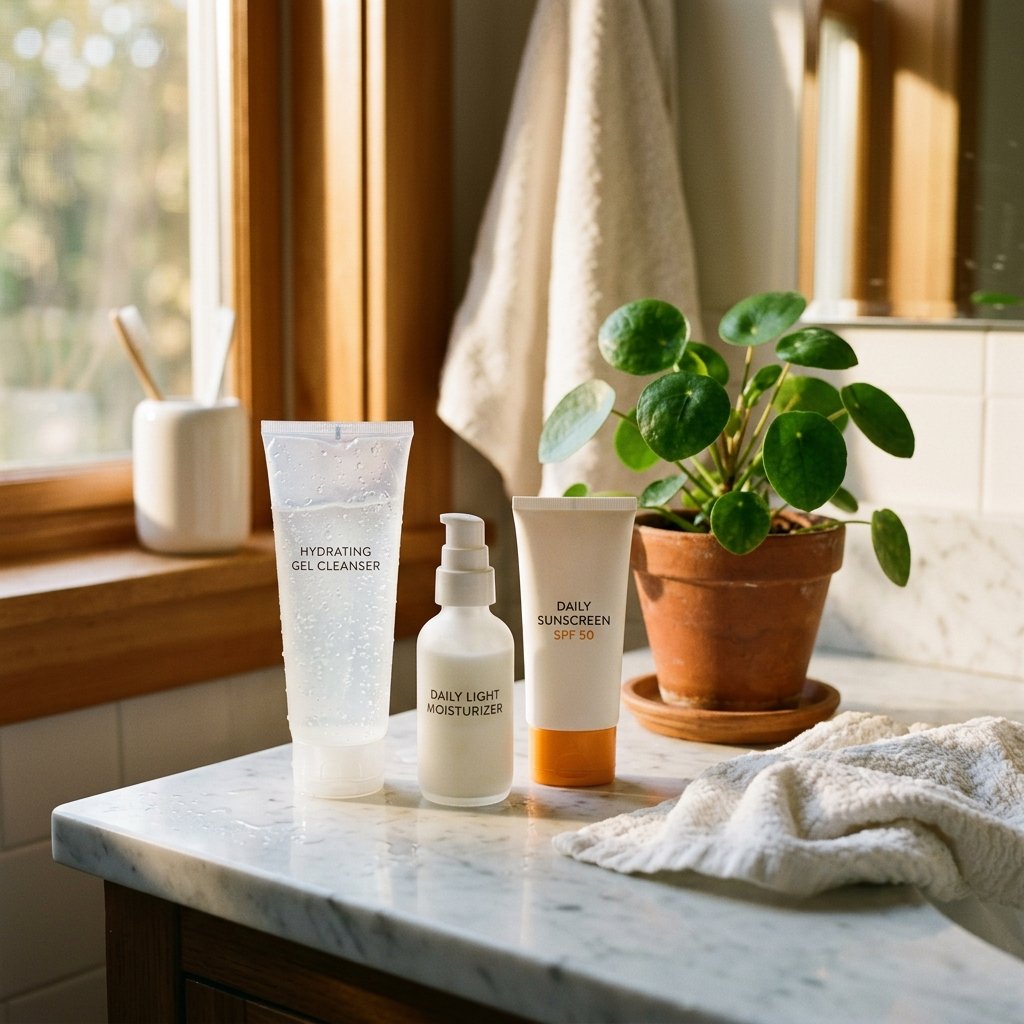

Let’s be honest — if you’ve ever opened a beauty app or walked past a Sephora and felt your head spin, you’re not alone. Skincare is one of those hobbies that looks impossible to get into, mostly because brands and influencers want you to feel like you need seventeen products and a chemistry degree just to wash your face.
Here’s the truth: you don’t. A proper skincare routine for beginners is genuinely four steps in the morning and three at night. That’s it. Everything else — the serums, the toners, the special once-a-week masks — is optional, and honestly, most of it can wait until you actually know what your skin needs.
This guide is written for the person who has never owned a skincare routine for beginners, or who has tried and given up because it felt too complicated. I’m going to walk you through exactly what to buy, exactly when to use it, and exactly why each step matters — without the fluff and without pretending you need more than you do.
Before we get into the routine, though, let’s clear up one thing that confuses almost every beginner: a skincare routine for beginners should always start with the basics, not the extras.
The biggest mistake beginners make isn’t buying the wrong products. It’s starting with too many of them, all at once.
When you introduce five new products in a single week, if your skin breaks out or gets irritated, you have no idea which one caused it. You’re stuck guessing, and usually you end up blaming the wrong one and ditching something that would’ve worked great.
So here’s the rule that will save you months of frustration: introduce one new product at a time, and give your skin at least a week to tell you how it feels. If nothing bad happens, add the next one. This is how you actually learn what your skin likes, and it turns a skincare routine for beginners from a guessing game into something you can control.
The Basic Ingredients You Actually Need
Let’s be blunt about what belongs in a beginner routine, because the list is shorter than you think.
You need a cleanser, a moisturizer, and a sunscreen. That’s the minimum that most dermatologists agree on, and the American Academy of Dermatology has a handy breakdown of the basics if you want the official version.
Optionally, once your skin is comfortable with those three, you can add a single active ingredient like a gentle exfoliant or a vitamin C serum — but only after the basics are solid. Jumping straight to actives is how beginners end up with a damaged moisture barrier and a cabinet full of half-used bottles.
A Skincare Routine for Beginners in the Morning: 3 Steps
The morning half of your skincare routine for beginners is short, and it’s mostly about protection. Your skin needs to be clean, hydrated, and shielded from the sun before you step outside. Here’s the order, and yes, the order matters.
Cleanse (Gently!)

In the morning, your skin isn’t dirty — it’s just been sitting in bed collecting a little oil while you slept. That’s why your morning cleanse should be gentle, and honestly, some people can get away with just splashing water on their face.
But if you’re a beginner and you want a proper skincare routine for beginners, use a mild cleanser. Look for something labeled “gentle” or “hydrating” rather than anything that says “deep clean” or “purifying,” because those tend to strip your skin more than they help. You want to remove the leftover oil without leaving your face feeling tight and squeaky — remember, that squeaky feeling is your skin telling you it’s been over-washed.
Moisturize
Right after cleansing, while your face is still slightly damp, apply a moisturizer. This is the same trick we talked about in our guide to building a body care routine, and it works just as well on your face — damp skin holds the moisture in, which means you use less product and get better results.
For a beginner, a simple, fragrance-free moisturizer is the safest bet. You don’t need anything fancy. Just something that hydrates without feeling heavy or greasy. Your skin will let you know pretty quickly whether it likes the texture.
Sunscreen (This Is Non-Negotiable)
This is the step that most beginners skip, and it’s also the one that matters the most long-term. Sun damage accumulates silently over years, and it’s responsible for the majority of visible aging — the wrinkles, the dark spots, the loss of firmness that you’re probably trying to prevent in the first place.
Use a broad-spectrum sunscreen with at least SPF 30, every single morning, even when it’s cloudy, even if you’re just driving to work. It should be the last step of your morning routine, on top of your moisturizer. Once it becomes a habit, it takes about thirty seconds.
If you’re worried about sunscreen feeling greasy, look for one labeled “matte” or “oil-free” — there are plenty of lightweight options that feel like nothing on the skin, like the EltaMD UV Clear sunscreen we reviewed.

The Night Half of a Skincare Routine for Beginners: 3 Steps
Your nighttime routine is where the actual repair happens. While you sleep, your skin goes into recovery mode, and it’s far more receptive to what you put on it. So the night half of a skincare routine for beginners is a little more involved than the morning, but it’s still simple.
Remove Your SPF and Cleanse
Here’s the thing that trips people up: the sunscreen you put on in the morning needs to come all the way off at night. It’s not enough to just splash water on your face and call it done.
If you wear makeup or a heavy sunscreen, you might need to double-cleanse — using an oil-based cleanser or a micellar water first to break down the sunscreen and makeup, and then a regular cleanser to actually wash your face. If you’re only wearing a light layer, a good single cleanse will usually do the trick. We covered the whole subject of how to pick a makeup remover in our guide, but the short version is: match the remover to how much you’re wearing.
Moisturize
Same as the morning, but you can go a little richer at night if your skin tends to be dry. Nighttime moisturizers are often creamier and heavier because your skin has the whole night to soak them in. Once again, keep it simple for now — a basic night cream or even the same moisturizer you use in the morning works fine for a beginner.

Apply Any Treatments (Optional)
This is the slot where your optional active ingredients go, the ones you’ll add later once your basics are solid. An example would be a retinol or a gentle exfoliating acid. These go on after cleansing but before your moisturizer, and only at night, because they make your skin more sensitive to the sun.
Don’t start these in your first week. Get comfortable with the basics first, then consider adding one at a time.
How to Choose Products for a Beginner Skincare Routine
Now that you know the steps, here’s how to choose the actual products without getting overwhelmed. The rules behind choosing products for your skincare routine for beginners are simple, but they’ll save you a lot of wasted money.
For a beginner, look for products that are fragrance-free. Fragrance is one of the most common triggers for skin irritation, and it adds absolutely nothing to how well a product works. If it’s labeled “for sensitive skin,” that’s usually a good starting point, even if your skin isn’t sensitive — it just means the formula is gentler.
Avoid anything that promises overnight results or dramatic before-and-after transformations. Real skincare is slow and consistent. A product that promises an instant miracle is either a scam or so harsh it will do more harm than good.
Stick to well-known, well-reviewed products. You don’t need the most expensive version of anything — plenty of dermatologist-recommended drugstore options work just as well as the premium brands. And as we mentioned in our review of CeraVe’s moisturizing cream, some of the best formulas on the shelf are the affordable ones.
The Mistake Most Beginners Make: Starting With Actives
I keep coming back to this, but it’s worth saying clearly because it’s the #1 reason people damage their skin in the first few months.
Actives are the strong stuff — acids, retinoids, vitamin C — and they’re genuinely useful, but only when your skin is ready. If you start with a chemical exfoliant and a retinol on day one, before your skin has adapted to a basic routine, you’re asking for redness, peeling, and breakouts.
Start with just the cleanser, moisturizer, and SPF. Give your skin two to three weeks to get used to them. Only then, if you have a specific concern, add one active at a time, always starting at the lowest strength and the lowest frequency, like a couple of nights a week. If you ever want the science behind chemical exfoliation, the Cleveland Clinic has a clear explanation of why gentle, regular exfoliation beats aggressive scrubbing.
How Long Before a Beginner Skincare Routine Shows Results?
Let’s set honest expectations, because this is where most people quit.
Cleansing, moisturizing, and sun protection will make your skin feel cleaner and more hydrated almost immediately. Those subjective improvements show up within the first couple of weeks.
But real, structural changes — the fading of dark spots, the smoothing of texture, the reduction of fine lines — take time. Skincare operates on the skin’s natural cell cycle, which is roughly a month. So expect to judge your skincare routine for beginners after eight to twelve weeks of consistent use, not after a week.
If you expect to see massive changes in a few days, you’ll be disappointed and give up. If you understand that this is a slow, steady process, you’ll actually stick with it and get the results.
Common Beginner Mistakes to Avoid
A few quick things to steer clear of, because they’re so common that most people don’t even realize they’re doing them.
- Changing products too often. Give each product at least a couple of weeks before you decide it’s not working.
- Over-washing. Washing your face more than twice a day strips your skin and makes oil production worse.
- Skipping sunscreen on cloudy days. UV rays come straight through clouds.
- Using too much product. A pea-sized amount of moisturizer is usually plenty.
- Going to bed with makeup or SPF on. This blocks your skin from repairing overnight.
- Expecting overnight results. Everything good in skincare is slow.
Building a Skincare Routine for Beginners Into a Habit
The science is simple; the hard part is actually building your skincare routine for beginners into something you do every day. So here’s some practical advice on making this stick, because a routine you actually follow beats a perfect routine you abandon after a week.
Keep your products visible. If they’re tucked away in a drawer, you’ll forget them. Put your morning products next to your toothbrush and your night products next to your bed or wherever you wind down.
Do it at the same time every day. Routine is easiest when it’s attached to something you already do, like brushing your teeth. Anchor your skincare to that existing habit and it becomes automatic much faster.
If you miss a day, don’t beat yourself up and don’t quit. Just get back to it the next morning. Consistency over weeks and months is what matters, not perfection on any single day.
The Bottom Line
A skincare routine for beginners really is this simple: cleanse gently in the morning, moisturize, and put on sunscreen. At night, remove the sunscreen, cleanse, moisturize, and optionally layer a treatment once you’re ready.
Start with the basics, add one product at a time, and give your skin time to adapt. Skip the harsh actives until your foundation is solid. And above all, be patient — a good skincare routine for beginners is a marathon, not a sprint, and the people with the best skin are usually the ones who stuck with a simple routine for a long time, not the ones who chased every new launch.

Build the habit, protect your skin from the sun, and let consistency do the work. That’s genuinely all there is to it.